A competitor receiving more citations is a reason to inspect the sources, not an instruction to buy more placements. The useful gap is a buying question that relevant evidence answers for the competitor but leaves unresolved for your brand. Start with the recommendation and the passage supporting it. Domain totals alone cannot tell you what content to produce.
Identify the claim each source actually supports
Choose a small set of important customer questions where the competitor appears repeatedly. Keep the complete answer, date, platform and question beside each source URL. Open the cited page and record the relevant passage, its product or service scope, and any date or qualification. A link to the competitor’s domain does not mean every statement in the answer is supported by that page.
Separate three observations: the brand was mentioned; a URL was cited; a cited passage supports a particular recommendation. For example, a directory can name a supplier without substantiating its lead time. A technical sheet can support a material specification without recommending the company. Keep an unsupported recommendation marked unresolved rather than assigning it a convenient source.
Save the exact URL and retrieval date. If the live page differs from the quoted material, record the discrepancy. An inaccessible page or a missing passage is an evidence limitation. It does not prove that the model invented the statement or never used an earlier version of the page.
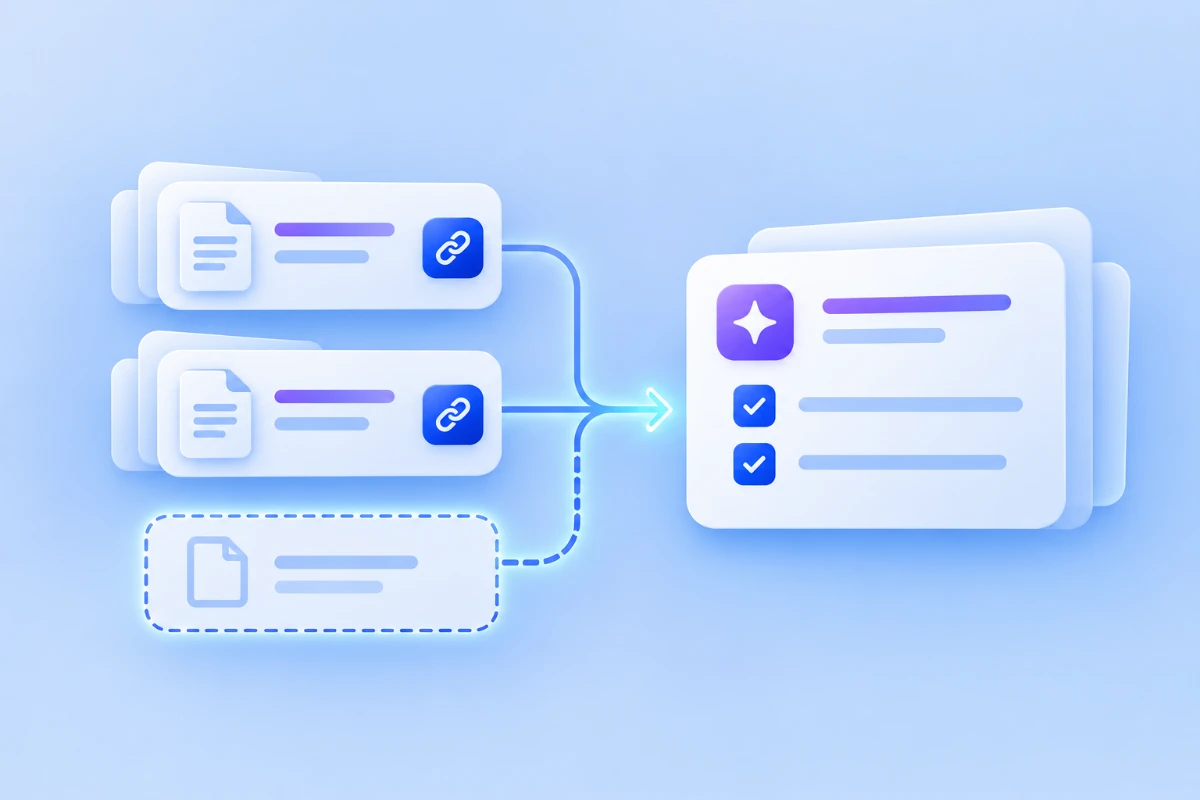
Use a source review to distinguish different gaps
Consider a buyer seeking 300 custom skincare cartons delivered to Germany. The following page descriptions and quotations are invented solely to demonstrate the review. In a real analysis, replace every cell with a captured passage and its URL. Do not present this table as a competitor test.
| Recommendation claim | What the source says | Finding from the review | Appropriate follow-up |
|---|---|---|---|
| Supplier A accepts 300 custom cartons. | Current product page: 300 units for one carton and single-colour printing. | Supported only within those stated limits. | Check our equivalent offer; publish its verified minimum and limits. |
| Supplier B can deliver to Germany in seven days. | An older review describes seven production days; shipping is not specified. | The source does not establish arrival time. | Keep production and shipping separate in our current delivery information. |
| Supplier C is suitable for this 300-unit order. | Current ordering terms require 500 units. | The recommendation conflicts with the stated requirement. | Exclude it from the relevant comparison; do not imitate its content. |
Choose between a page edit, new evidence and no action
For a verified requirement your product already meets, inspect the page where a buyer would expect the answer. If the fact exists only in a quotation email, publish the approved condition on the relevant product or service page. If it already appears clearly, investigate access, relevance and competing source support before creating another page that repeats it.
Some claims need evidence that a brand description cannot supply. A manufacturing specification may be supported by the supplier’s own controlled documentation. A claim about actual service experience needs a documented customer account or an independent evaluation appropriate to that claim. Select evidence for the question being answered; the mere presence of a third-party logo does not make it stronger.
Repeated citations can reveal a useful dependency. Group by exact page as well as domain, and note syndicated copies of the same article. One original specification cited many times may remain the right source. Ten copies of a press release do not become ten independent tests. Avoid using a more varied domain chart as the objective of the work.
Prioritize a gap when it affects a relevant buying condition, recurs in comparable observations, and can be addressed with information you can substantiate. If the product cannot meet the requirement, document the limitation and work on a better-fit segment. If the only evidence is one unverified answer, keep it in the research queue rather than commissioning content immediately.
Verify the published change before judging AI results
Give each selected gap an affected question, a target URL, the missing or incorrect passage, a responsible owner and an acceptance check. For the first row in the example, completion means a buyer can verify the applicable carton, print method and minimum order on the current page. An article being published somewhere is not, by itself, proof that the gap is resolved.
After publication, repeat the original question under the recorded conditions. Check whether the changed page is cited, whether its facts are represented accurately and whether the recommendation is appropriate. Keep the unchanged answers too. These observations show what happened after the edit, but they do not isolate its effect from other changes in search or model behaviour.
Google’s guidance for its AI search features keeps the focus on normal search eligibility and useful content; it does not offer a special markup requirement or a guaranteed route into an answer. A citation-gap review should therefore end with better, verifiable information for the buyer and a clear plan to observe results, rather than a promise of placement.
AskScope’s citation views can help locate the platform, source page and competitor associated with an observation. Open the source itself before deciding what to change. The analyst still needs to judge whether its passage supports the buying requirement and whether the proposed correction is accurate.